Why Are There Blank Pages in my Print Layout?

Contents
For a quick reference, before reading this article, you might peruse our section on "What's in a Book?"
Traditionally in print layout, certain page types appear on certain pages. For example, the title page and half-title page, if used, always appear on a right-hand page. The copyright page always appears on the back of a title page, its "verso" page (the reverse side, or left-hand page, is a "verso" page. A right-hand page is a "recto" page.) Here's a page from our production of Terence Stamp's Rare Stamps, to demonstrate how the Title Page and Copyright page work:
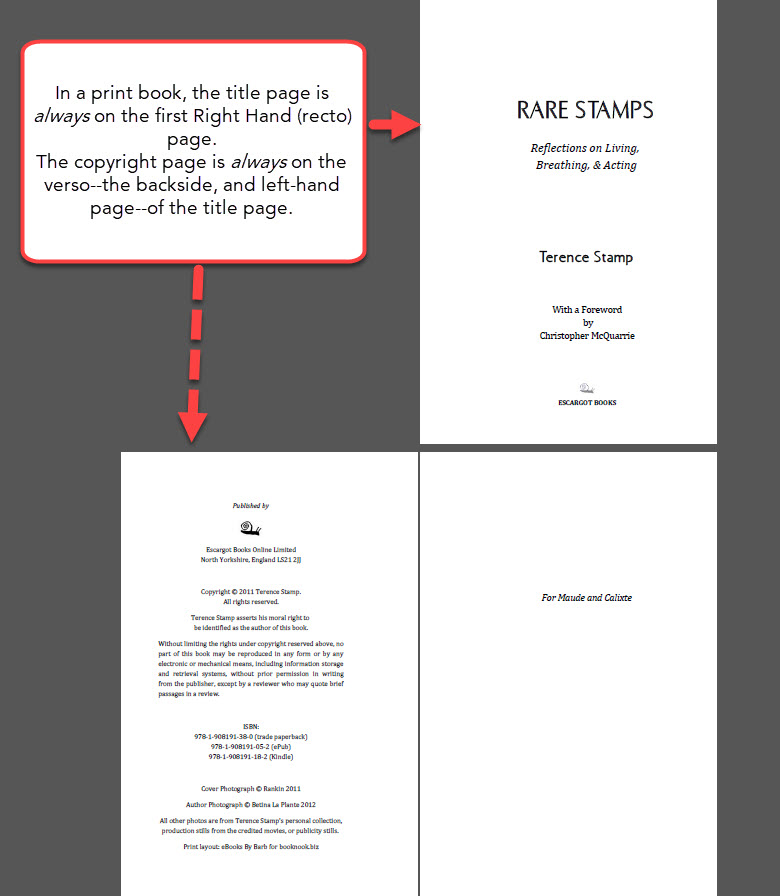
This is the interior layout PDF of Rare Stamps, showing how the Title page is the first right-hand (recto) page, and the copyright page is the verso (the backside, obviously a left-hand page) of the Title page.
The first page of the first chapter of a book, is always on a recto page (right-hand page), which is always an odd-numbered page. That's typically page 1, in fact, with roman numerals being used for the front-matter pages. Oftentimes, publishers will choose to have every new chapter start on a new recto page. To do that, we sometimes need to insert what we call "push pages," or blank pages. Think of it this way—if Chapter 3 ends on a right-hand page, how can Chapter 4 start a new page there, as well? Obviously, it can't. So, we insert a new blank page, on the back—the verso—of the last page of Chapter 3, and then a fresh new page for Chapter 4 to start.
Again, here's an example from Rare Stamps:
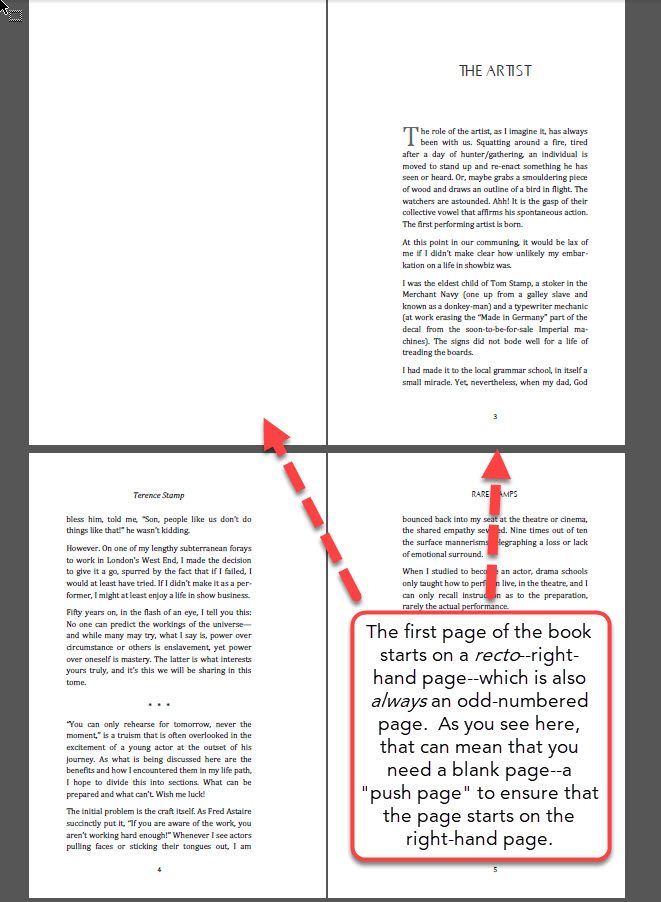
The first page of the first Chapter of Rare Stamps, showing the "push page" (the blank page) on the left, enabling the first Chapter page to start on the right-hand (recto) page. Note that all right-hand pages in a book are always odd-numbered pages!
Most blanks in a print book are intentional, if you're using an experienced, professional bookmaker. If you're not, well, then, I can't speak to how those blanks got there or why they are there—but in a professional shop, there is typically a good reason. Just ask!