Widows, Orphans, and Squaring the Page

Contents
It seems that no matter what we do for layout, a client seems to want us to do something else. When we layout a book with squared pages (more on that below), clients will complain that there are widows and orphans. When we layout a book to avoid widows and orphans, they'll complain that the pages aren't squared. What's a designer to do?
Widows and Orphans
What are widows and orphans? In short, they're stub-ends, or stub-beginnings, of paragraphs. Most people, by the way, think that widows and orphans are the opposite of what they are, calling a widow an orphan and vice-versa—and here's something new, both are not typographic boo-boos. As per Bringhurst, the father of modern typography,
"Isolated lines created when paragraphs begin on the last line of a page are known as orphans. They have no past, but they do have a future, and they need not trouble the typographer. The stub-ends left when paragraphs end on the first line of a page are called widows. They have a past, but not a future, and they look foreshortened and forlorn. It is the custom—in most, if not in all, the world's typographic cultures—to give them one additional line for company." (Underscored emphasis added)
Now, the reality is, most of us remember hearing about widows and orphans when we were in school, religiously drilled to avoid them, but as Bringhurst mentions, we can ignore orphans entirely—but we should try to avoid widows. That's great, but...how is that done, exactly? (More below!)
Squaring the Page
What does Squaring the page mean? It simply means ensuring that the pages, especially those facing each other, all start and end on the same lines. So that if the first line of page 4 starts on the 8th line on the page, so too should page 5. Sounds like it shouldn't be too hard right?
It is, however, impossible to do, without affecting the text itself, if you are also avoiding widows and orphans. Here's an example of a squared page:
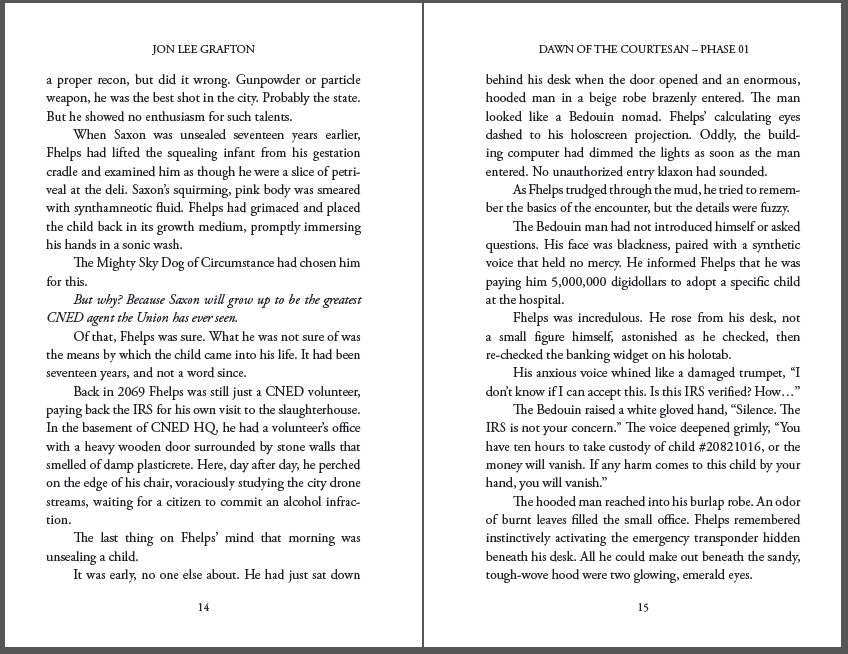
This is an example of a squared page, and as you see, the verso page 14 has an "orphan."
As you see, the verso page does indeed have a orphan. Without it, if we forced it to start on page 15, the pages would no longer be "squared." This is a commonplace dilemma—how do those big publishers fix this? Do they have typographers and tricks that you don't?
In short—yes, they do. Because a large publisher holds the final rights over the actual text of the book. When Random House's typographer calls up to the editor for "Love's Savage Savage," and tells her that she can't square the page on the pages 22-23 spread, what happens? One of two things—either the editor simply edits out what needs to be removed, or she asks the author to do it. It's that simple. The typographer tells the editor that she needs to lose 60 or 65 or 40 characters—and that's what happens.
In short—the text is changed. The typographer is not expected to spend half an hour or more, manually kerning the text, in order to avoid a widow on page 23. Those days are long gone, the hot lead days, when a top typographer would manually kern and lead text, to fit X characters onto a given page.
In summary:
What that means is, you can't have both, not unless you're willing to make those edits yourself, when you see the PDF that we provide to you. If you're relying on us, then you can choose—squared pages, or no widows and orphans—but you can't have both, not without some bloodletting. If you want both, then you need to wait, see the laid-out file and then get to work, cutting text where necessary (or adding it!), to avoid both un-squared pages and widows (as you don't have to worry about orphans—the prevalent belief that orphans are "bad" is wrong).
Don't forget—if you're going to make edits, to force pages to be squared—we charge for those types of revisions.